
Accessible Website: What the Accessibility Enhancement Act Means
Since June 28, 2025, many online shops and digital services must be accessible. We explain who is affected and what makes a website accessible.
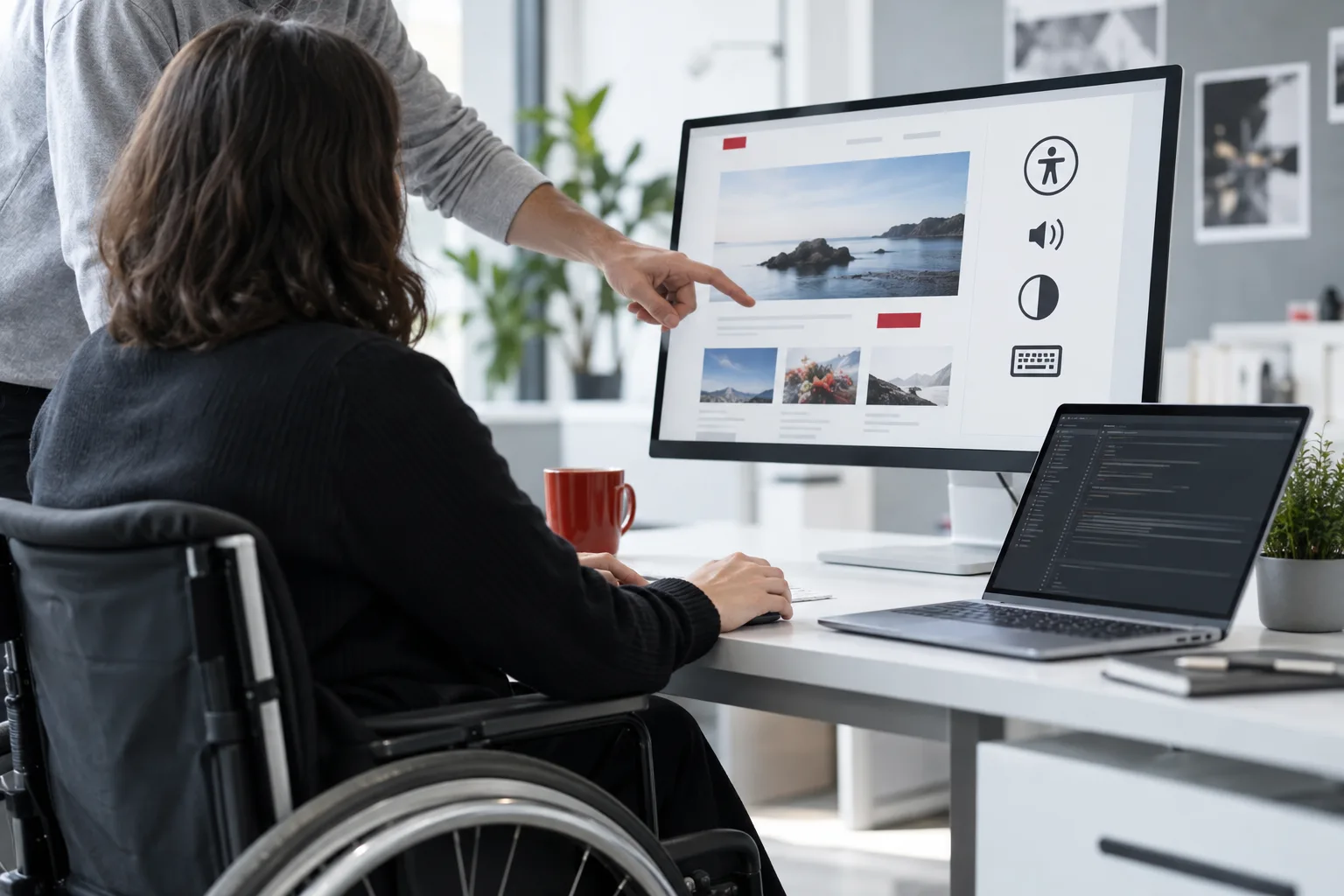
In short: The Accessibility Enhancement Act (BFSG) has been in effect since June 28, 2025. It requires companies offering certain digital services to consumers—especially online shops and booking functions—to make them accessible. Micro-enterprises with fewer than ten employees and an annual turnover or balance sheet total of no more than €2 million are exempt from accessibility requirements for services. However, accessibility benefits every website.
Note: This article provides general information and is not legal advice. Whether your company is affected should be reviewed on a case-by-case basis.
- Effective since June 28, 2025, implementing the European Accessibility Act.
- Primarily affects online shops and digital consumer services.
- Exemption for micro-enterprises regarding services—not products.
- Accessible websites are also easier for search engines and AI to read.
Who is affected by the BFSG?
The act covers, among other things, services in electronic commerce. This typically includes online shops where consumers enter into contracts. Purely informational websites without contract conclusion and purely B2B offers are generally not subject to the requirement. Micro-enterprises providing services are exempt; those marketing products cannot claim this exemption.
| Situation | Typical Classification |
|---|---|
| Online shop for consumers, company with 10 or more employees | generally affected |
| Online shop of a micro-enterprise | exempt for services |
| Informational website without contract conclusion | generally not affected |
| Pure B2B offer | generally not affected |
What makes a website accessible?
The Web Content Accessibility Guidelines (WCAG) provide orientation with four key principles: perceivable, operable, understandable, and robust. In practice, this means:
- Sufficient contrast between text and background.
- Alternative text for all informative images.
- Keyboard operability with visible focus indicators.
- Clear heading structure (H1, H2, H3) and easy-to-understand language.
- Labeled form fields and clear error messages.
- Scalable fonts without content loss.
- Subtitles or transcripts for videos.
What are the benefits of accessibility beyond legal requirements?
Accessible websites are easier for everyone to use—including older adults, users in low-light conditions on smartphones, or those with limited fine motor skills. Additionally, search engines and AI assistants benefit from clean structure, alternative texts, and clear headings. Accessibility directly improves your visibility.
How to proceed
- Check (or have checked) whether your offering falls under the BFSG.
- Analyze your website using automated tests and manual reviews.
- Set priorities: contrasts, alternative texts, keyboard navigation, forms.
- If required: create and publish an accessibility statement.
- Ensure accessibility with every new content update.
Common barriers on company websites
- Text presented as images, such as scanned price lists or opening hours.
- Light gray text on white background with insufficient contrast.
- Links labeled as “click here” without clear destination.
- Forms with fields labeled only by placeholder text.
- Cookie banners and pop-ups that cannot be closed via keyboard.
- Videos without subtitles.
Many of these issues can be fixed with minimal effort and immediately improve usability for all visitors.
Conclusion
Whether mandatory or voluntary: an accessible website reaches more people and performs better in search engines. MYPOINT incorporates accessibility in every web design project and during a website relaunch. Contact us.